If movie characters could read closed captions, they’d glimpse the future
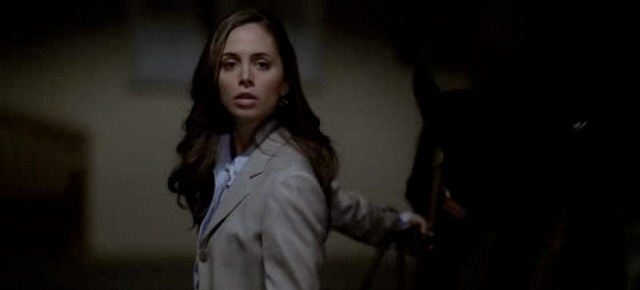
Caption readers sometimes know what’s happening before the characters themselves. In this way, captions tell the future.
If movie characters could read closed captions along with us, they’d be more efficient at fighting crime and solving mysteries. The world would be safer — as long as we didn’t let the bad guys read the captions too. The time traveling rhetoric of closed captioning makes this possible. By time-traveling, I simply mean that we sometimes know what’s happening before the characters themselves, not to mention before every viewer who is watching without the added benefit of captions.
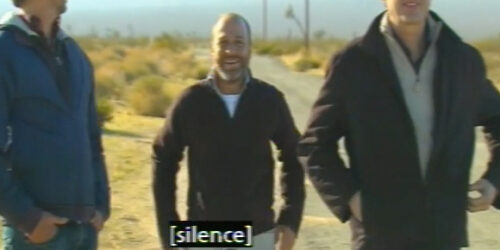
Consider a clip from Season 1, Episode 10 of the Fox TV show Dollhouse. The clip starts about 36 minutes into the episode. You can watch the full episode with captions on Hulu. In the clip, a man lurking in the shadows says something to Echo [Eliza Dushku]. Unable to see who it is, Echo responds, “Who’s there?” At which point, the man comes out of the shadows and Echo recognizes him as Nicolas.
But closed caption users knew it was Nicolas from the moment he started to speak from the shadows, because the caption had identified him as Nicolas. Even if this is just another case of lazy or careless captioning, it nevertheless demonstrates the potential for captions to make time travel possible.
If Echo had access to that prescient caption, who knows what she could have done. Probably nothing more than saved herself (and us) a little time and suspense. From the viewer’s perspective, knowing the future has a price as well. No longer do we ride that same wave of suspense with Echo. We know right away that it’s Nicolas skulking around in the shadows. Now get on with the show already.
Closed captioners need to consider carefully how captions affect the emotional arc and intensity of a scene or show. Captions must always be situated. The captioning convention that calls for the identification by name of any speaker who is off-screen or hidden should not be invoked in this case. The need to build suspense in this particular scene trumps the need to identify speakers who are off-screen (or obscured by that terrifying darkness). In other words, the practice of captioning should be rhetorical. Captioning, done well, demands that conventions be applied flexibly. A rhetorical approach uses purpose, genre, structure, emotion, content, and audience to determine the best course of action when captioning examples like the one presented here.
[In case you’re wondering why the captions don’t look like Hulu’s, I captioned this example myself using a Quicktime Text track and then compared my captions and the timings to the captioned version on Hulu to make sure I was following the original closely. Compare my captions with the original version on Hulu.com]
[Fair use notice: The videos on this site are transformative works used in good faith, in keeping with Section 107 of U.S. copyright law, and as such constitute fair use of copyrighted material. Read this site’s full fair use notice.]

Thanks! Never thought about that. I tend to do that with the captioned trailers too – I should probably say “male voice” instead of a character name? What about characters that non-caption users don’t know? I have been looking up character names on imDb to label who is speaking, instead of saying the non-descript “male voice”, thinking I was doing a good thing.
Bill, it’s almost always a good thing, as you know very well, to identify off-screen characters by name. But I don’t think we should try to give captioned viewers more information than the movie is ready to share. We need to let the specific context of the movie guide decisions about what and how to caption, so caption viewers can ride that same emotional wave of surprise and suspense.
Thanks for your comment!
Sean
To recreate the same experience the hearing audience gets, maybe we should we use smaller type, and obscured letters. Sometimes I listen to a trailer 3/4/5 times to try to understand the words, and often I put subtitles on music because I was looking it up anyway trying to figure out the lyrics.